Your China & Yunnan Travel Experts


Reviewed August 27, 2026. China's air, high-speed rail, metro and road networks give older travelers many workable choices, but “senior-friendly” depends on the individual journey. Build each leg from hotel door to hotel door, including stairs, lifts, luggage, security, waiting time, seat type, toilets and arrival hour. This guide replaces blanket claims with a practical decision sequence. Travelers with chronic conditions or mobility concerns should discuss the itinerary with an appropriate clinician and request operator assistance early; this page is not medical advice.
Compare nonstop and protected connecting flights, but also check airport distance and arrival time. For rail, use the official 12306 channel, enter the foreign passport exactly and keep that original document for boarding. Popular dates can sell out, while schedules and sales windows change; verify live inventory rather than relying on an old timetable. The China high-speed train guide explains stations and seat classes in more detail.
Do not assume a universal airline, railway or attraction discount based only on age. Eligibility, nationality, route and required identification differ, and third-party labels can be misleading. Compare the final price, baggage, refund rules and support channel. Assistance is separate from a discount: ask the carrier or station what service can be reserved, the request deadline, meeting point and whether each connecting segment needs its own booking.
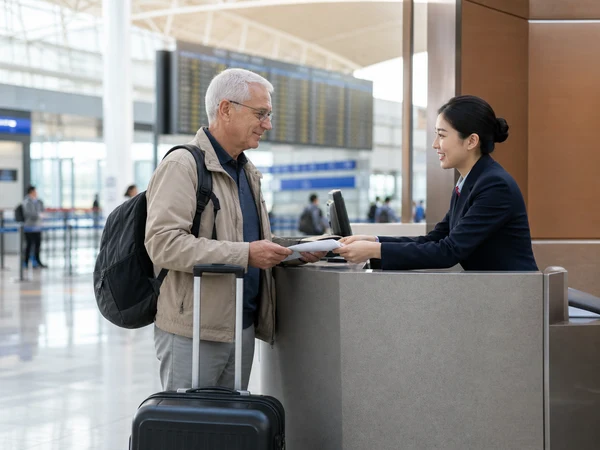
Choose comfortable, nonrestrictive layers and stable, broken-in footwear. Cabin and carriage temperatures may differ from the platform, while long seated periods affect individuals differently. Follow personal medical guidance for movement, compression garments or medication rather than generic internet claims. Keep the aisle clear, use handrails and stand only when the vehicle is stable.
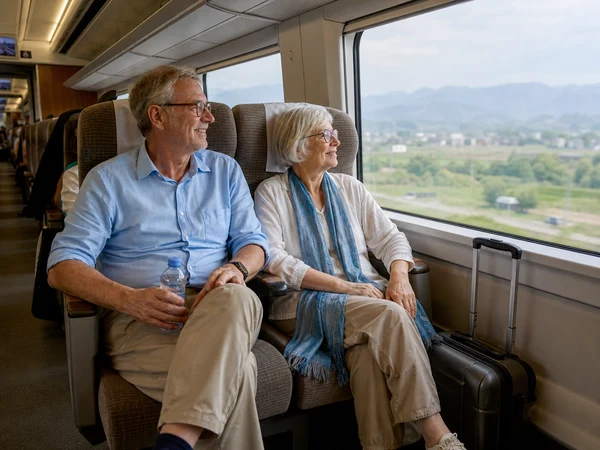
Older travelers seated in practical clothing on a daytime high-speed train
Carry necessary medicine in cabin baggage in original pharmacy packaging, with prescriptions and a concise medicine list. Allow for a reasonable delay margin and check airline security, quantity, liquid, refrigeration and controlled-medicine rules before departure. Ask a clinician how to handle time-zone changes; do not improvise dose timing. Split critical supplies only where medically appropriate, and never place the only supply in checked luggage.
There is no reliable national rule that every airport needs exactly two hours or every train exactly forty minutes. Use the airline's or 12306's current advice, then add time for the actual terminal, passport checks, station security, lifts, queues, assistance meeting point and unfamiliar navigation. Large Chinese stations can have multiple entrances and long internal routes. The China transportation overview helps identify the correct mode and station.
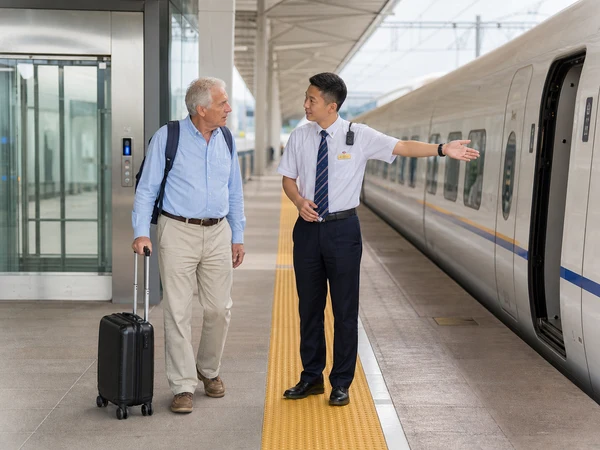
Station staff guiding an older traveler toward the correct high-speed train carriage
Avoid the busiest commute or holiday period when the itinerary allows, but do not step into unsafe road space or rush through closing doors to escape a crowd. Use lifts, official waiting areas and seated transfer points. Keep one hand free, wear a small secure bag in front in dense areas and agree on a meeting point if companions separate. In taxis and private vehicles, use the seat belt and enter from the safer curb side where possible.
Use a staffed, step-free route instead of treating a novelty ride as essential transport
China Railway 12306 describes a special key-passenger reservation for travelers who need extra care because of age, mobility or physical condition. The current Chinese service notice says online requests should normally be submitted at least six hours before departure; later requests should be made at the station within the stated cutoff, and each connecting train segment needs its own request. Some stations provide priority processes, guidance, boarding help and wheelchairs, but facilities vary. China's civil aviation regulator published new disability-support capacity measures in 2026, while actual advance notice, mobility-device handling and handoffs still need confirmation with the chosen airline and airport.
Carry safely treated water after security where permitted, but individual fluid needs and restrictions differ. Travelers with heart, kidney or other conditions should follow clinical advice rather than a universal target. Identify toilet locations before boarding, choose an aisle seat when useful and pack a small appropriate snack. Alcohol and excess caffeine can complicate sleep or hydration for some travelers; decide with personal health guidance, not a blanket rule.
A daytime leg often makes navigation and hotel arrival easier, but an overnight sleeper or late flight can still be reasonable when the traveler sleeps well in transit and the arrival plan is secure. Compare berth privacy, toilet access, stairs, pickup time and the following day's demands. Do not save one hotel night only to lose the next sightseeing day. Keep the first activity after a late arrival optional.
Keep the passport and ticket document in one secure on-body place, with cash and cards divided between locations. Photograph luggage and save hotel details offline. Use only official taxi queues or clearly identified ride-hailing pickups, verify the vehicle and do not display valuables unnecessarily. This is ordinary travel discipline—not a claim that older people are inherently helpless or that one city is absolutely safe.
For each leg, write down the terminal or station in English and Chinese, booking document, seat, luggage rule, assistance reference, hotel transfer and a fallback. Reconfirm schedules shortly before travel and keep one local contact who can help without taking control away from the traveler. Use the contact form to request a route review that states walking, lifts, luggage and transfer assumptions rather than simply calling the trip easy.

Older travelers at a Guilin countryside viewpoint

From $ 1599

From on request

From $ 23332100
Editorial accountability
Hu Lei, CEO. The named owner is responsible for travel-planning accuracy and escalation of time-sensitive checks.
Yuntian Travel (Yunnan) Group is identified in its corporate profile as a licensed professional inbound travel service provider based in Kunming, China. Registration and travel-service documents can be requested before booking.
Page-specific references where cited, official destination, transport and entry notices, YUNSKY route-planning records, and direct provider confirmation before a booking is finalized.
Content is reviewed when rules, transport, access, pricing or route conditions change. Final availability and operating details are reconfirmed for each traveler’s dates.
Quality review: Page updated: